CBSE Co-Scholastic Assessment: What Schools Get Wrong in 2026
If you run a CBSE-affiliated school in 2026, CBSE co-scholastic assessment has quietly stopped being the easiest part of your reporting cycle. Between NEP 2020, NCF 2023, the PARAKH-led Holistic Progress Card, and the now-mandatory SQAA self-assessment, the expectations on how you grade life skills, values, work education, art education, health and PE, and discipline have changed faster than most schools have updated their internal practice. The result: principals are signing off on co-scholastic grades that are technically compliant with the old A–E or A–C scales but increasingly out of step with where the system is heading.
This post is for principals and academic heads who already know the basics and want a candid diagnostic. By the end, you will have a clear list of the seven failure modes we keep seeing in Indian CBSE schools, a translation of NEP/NCF expectations into operational changes you can actually run, and a 90-day fix plan that does not require new hires or burning out your existing teachers.
Why CBSE Co-Scholastic Assessment Matters More in 2026
Three policy shifts have moved co-scholastic assessment from the back page of the report card to the centre of school quality conversations.
First, NEP 2020 explicitly redefines the report card as a "holistic, 360-degree, multidimensional" document covering cognitive, affective, and psychomotor domains. Second, NCF 2023 operationalises the 5+3+3+4 structure (ages 3–18) and ties competency-based, school-based assessment to each stage. Third, PARAKH (the national assessment centre under NCERT) has now developed Holistic Progress Cards across the Foundational, Preparatory, Middle and Secondary stages. The Rashtriya Sarvekshan 2024 alone covered around 23 lakh students from approximately 88,000 schools — this is system-wide infrastructure, not a pilot.
Layer on CBSE Circular 14/2023, which made annual SQAA self-assessment mandatory from session 2023–24 onwards for any school seeking fresh affiliation, switch-over, upgradation or extension. The "assessment" and "student learning outcomes" domains in SQAA cannot be filled in honestly if your co-scholastic grading is a tick-box exercise.
What Does CBSE Mean by 'Co-Scholastic' Today?
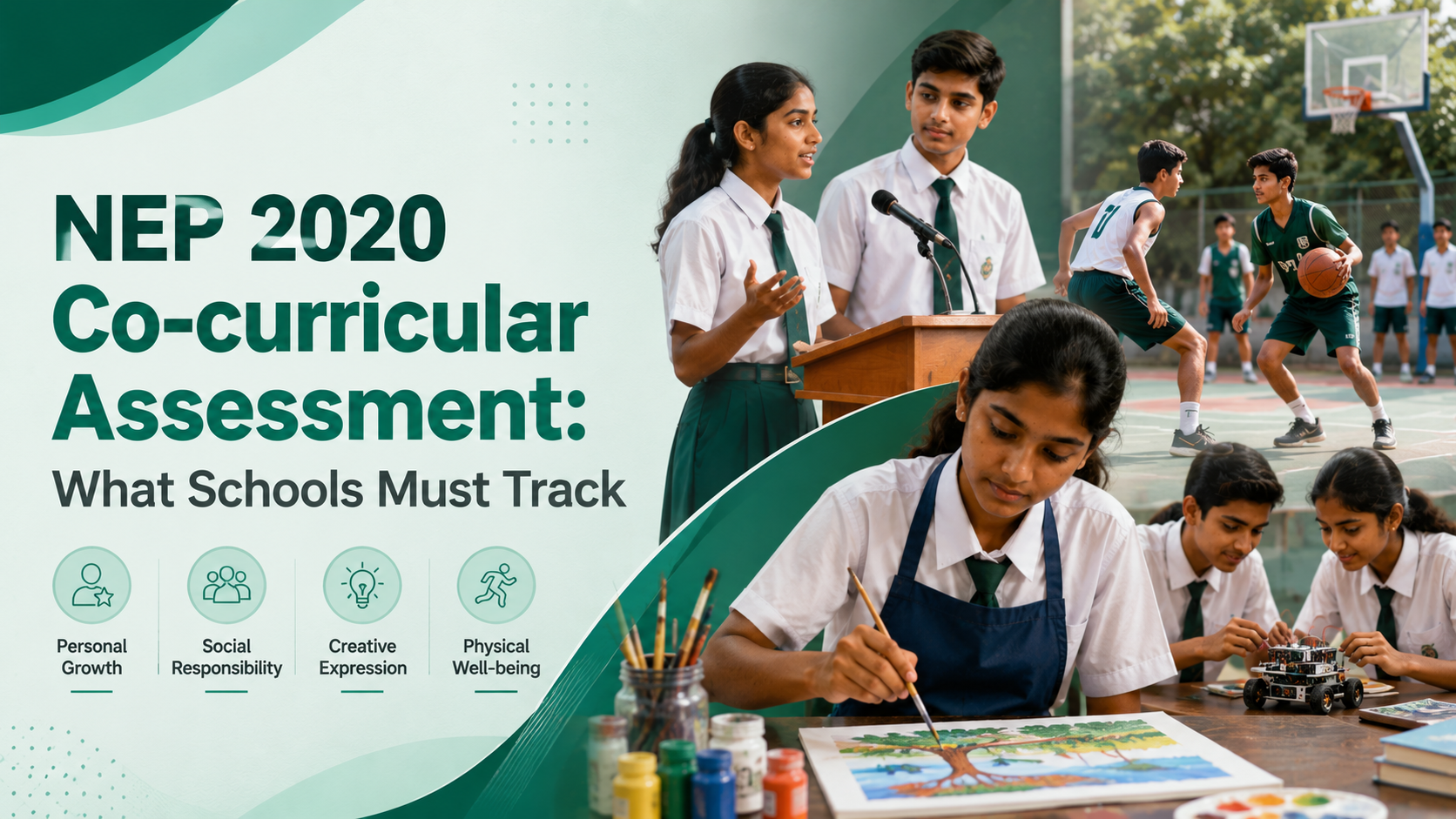
CBSE's own curriculum and CCE manuals define co-scholastic areas as: life skills (thinking, social, emotional), attitudes and values, work education, art education, health and physical education, discipline, and co-curricular participation (literary, scientific, artistic, sports). At the secondary stage, HPC frameworks extend this further into self-reflection, research skills, time management and career-readiness.
Two things have changed in framing:
These domains are now treated as competencies to be evidenced, not traits to be remarked upon.
They are expected to be captured through multiple perspectives — teacher, self, peer, and parent — not just a single homeroom teacher's term-end judgement.
Seven Common Mistakes Schools Make in Co-Scholastic Assessment
After enough conversations with CBSE principals, the same patterns surface. None of these are exotic; they are the default state of most schools that have not actively redesigned their co-scholastic process since 2020.
Last-minute grading. Co-scholastic grades are filled in the week before report cards print, from memory. There is no continuous record.
No evidence trail. A student gets a "B" in life skills, but the school cannot point to a single observation, artefact, or rubric entry that supports the grade.
Generic descriptors. Every report card carries near-identical sentences: "shows interest in activities", "is well-behaved". This fails the NEP 2020 test of reflecting each learner's uniqueness.
No student voice. PARAKH's HPC explicitly expects self-assessment and peer input. Most CBSE schools collect neither in any structured way.
No linkage to pedagogy. Co-scholastic assessment runs parallel to teaching rather than feeding back into it. A drop in "teamwork" never reaches the class teacher's planning.
Co-scholastic isolated from academic data. Two separate registers, two separate conversations with parents, no integrated view of the child.
Compliance-only SQAA submissions. Self-assessment scores in SQAA are reverse-engineered to look acceptable, rather than used as a genuine improvement diagnostic.
If three or more of these describe your school, you are not behind — you are mainstream. But mainstream is exactly what the system is moving away from.
How NEP 2020 and NCF 2023 Expect You to Assess Beyond Marks
Translated into principal-level expectations, the policy stack is fairly concrete:
Policy expectation | What it means operationally |
|---|---|
360-degree, multi-source feedback | Inputs from teacher, student, peer, and parent for each reporting cycle |
Competency-based assessment | Defined indicators per domain, not vibes-based remarks |
Continuous, formative emphasis | Evidence collected through the term is reported periodically |
Multiple tools | Anecdotal records, rubrics, checklists, portfolios, project work, performances |
Three developmental goals (HPC) | Health and well-being, effective communication, and involved learners |
Notice what is not on this list: a longer report card, a new ERP, or an exam diet. The reform is about evidence quality, not paperwork volume.
Are Your Co-Scholastic Grades Backed by Evidence?
Run this quick audit. For one randomly chosen student from Class VII and one from Class IX, ask:
Can the class teacher produce three dated observations from this term that justify the co-scholastic grade?
Is there a rubric the teacher used, and would a different teacher applying the same rubric arrive at a similar grade?
Did the student self-assess against any of these domains?
Is there a portfolio artefact (project, performance log, club entry) attached?
Most schools fail this audit not because teachers are careless, but because nobody designed the evidence pipeline. CBSE's own CCE-era documents recommend anecdotal records, rating scales, behavioural checklists, and portfolios — these tools have been on the table for over a decade. They are still the right starting point.
From 3-Point and 5-Point Grades to a Single Holistic Score
CBSE currently uses a 3-point A–C scale for classes I–VIII and a 5-point A–E scale for classes IX–X on co-scholastic areas. These scales are fine as compliance instruments. They are poor as developmental signals — the variance is too narrow to drive teacher action or parent conversations.
This is where an aggregated approach helps. The Reportify framework, developed at the IIM Lucknow Enterprise Incubation Centre, structures co-curricular and co-scholastic evidence across 619 events mapped to 6 categories and 68 sub-categories, scored on five dimensions (Skill Relevance, Participation Volume, Achievement, Temporal Consistency, Competition Intensity) and rolled up into 12 skill domains, including Critical Thinking, Communication, Teamwork, Leadership, Empathy, and Citizenship. Academic Score (0–5) plus CSD Score (0–5) gives a Holistic Score (0–10).
A useful equity feature: just 5–6 intra-school events across different categories can produce a CSD score of 4.5+, meaning rural and tier-3 schools without national-circuit access still surface strong holistic profiles. This matters because NEP/NCF compliance cannot mean "schools with a budget to send teams to nationals win."
Reportify is NEP 2020 and NCF 2023 aligned, not CBSE-mandated. The point of mentioning it is not endorsement — it is to show that aggregating co-scholastic evidence into a single, defensible number is feasible without inventing a parallel reporting system.
Inside the Holistic Progress Card: What CBSE and PARAKH Actually Want
The HPC is no longer a report card. It is a different instrument, with four design features your current format probably misses:
Multi-domain indicators rather than subject-by-subject remarks
Evidence sources (artefacts, observations, self-reflections) are attached to each domain
Multiple perspectives from the teacher, student, peer, and parent
Three developmental goals running across all stages — health and well-being, effective communication, and involved learners
If your current report card cannot show, for any one student, what evidence sits behind the co-scholastic grade and which perspectives contributed to it, you are working with a CCE-era artefact in an HPC-era system.
Building Teacher Capacity Without Burning Them Out
The single most common reason co-scholastic reform fails is that schools try to do everything in term one. Don't.
Pick two or three priority domains per stage (e.g., Communication, Teamwork, Self-Discipline for the middle stage).
Build one rubric per domain, with three to four observable indicators.
Schedule two evidence-collection windows per term, not continuous logging.
Use existing activities — class discussions, group projects, sports periods, club sessions — as evidence sites.
Bring co-scholastic into PLC meetings alongside academic data.
This is enough to clear the SQAA self-assessment bar honestly and to give parents a real conversation at PTMs.
What to Show Parents on the New Holistic Report Card
Indian parents are still mark-driven, and that is not going to flip overnight. The translation that works in practice:
Lead with the academic data they expect.
Add a one-page co-scholastic summary with scores, two narrative lines, and a domain icon set.
Show growth over time rather than a single snapshot.
Invite parent input for the next cycle — it sets up the multi-perspective expectation gently.
Once parents see a richer profile, demand pulls the system forward. Schools that have rolled this out report fewer "why did my child get a B" disputes, not more.
Where to Start in 2026: A 90-Day Co-Scholastic Fix Plan
A realistic, low-friction sequence:
Days 1–15: Audit current co-scholastic practice against the seven mistakes above. Be honest. Use the SQAA assessment domain as your scaffold.
Days 16–30: Pick two stages (say, Middle and Secondary) and three domains each. Draft rubrics. Train homeroom and activity teachers in one workshop.
Days 31–60: Run the first evidence-collection window. Class teachers log observations into a shared system — paper or digital. Begin self-assessment for one domain.
Days 61–90: Compile a pilot holistic snapshot for one section per stage. Share with parents at the PTM. Capture feedback. Refine before you scale.
If you want to see how an integrated holistic score behaves on real student profiles before you build internally, the free Skill Analyser lets you plug in sample data and visualise the output. For a deeper look at how schools actually run this, see how schools implement Reportify.
Bringing it all together
CBSE co-scholastic assessment in 2026 is not waiting for one big circular. NEP 2020, NCF 2023, PARAKH's HPC, and CBSE's own SQAA framework are already telling principals where this is going — towards evidence-based, competency-based, multi-source assessment integrated with academics. The schools that will look prepared in three years are the ones that fix the seven mistakes now, not the ones that wait for a mandate. Start narrow, build the evidence pipeline, integrate with the academic record, and bring parents along. The policy is on your side; the operating model just needs to catch up.
Try the Skill Analyser to see how a holistic score works on real student profiles
See how schools implement Reportify at /schools
Book a demo at /contact