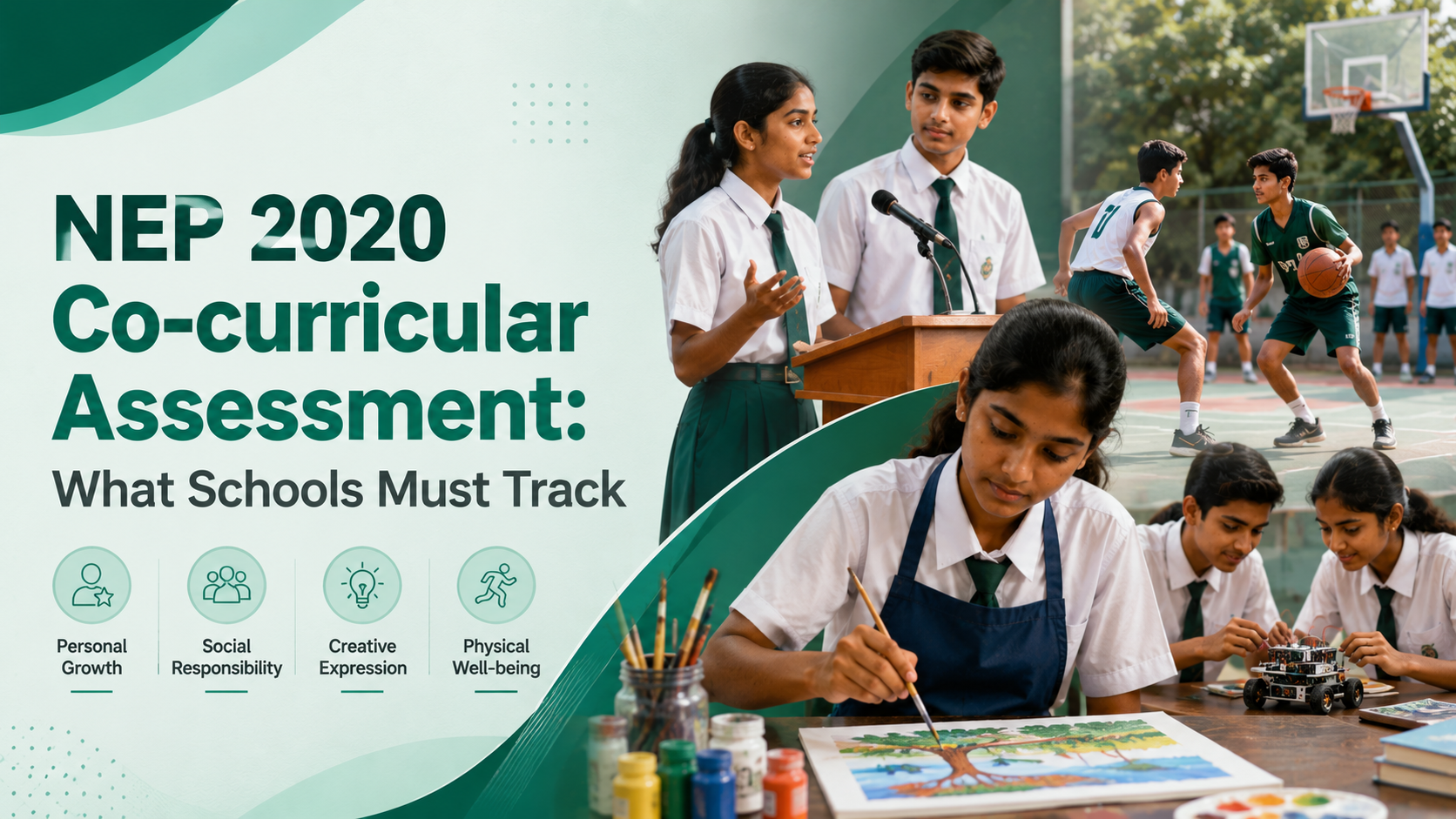
NEP 2020 Co-curricular Assessment: What Schools Must Track
India’s education system is moving steadily toward holistic assessment, and NEP 2020 co-curricular assessment is now becoming a practical leadership challenge for schools. Principals are no longer being asked only about board results or classroom instruction. Increasingly, they are expected to show how students develop communication, teamwork, leadership, creativity, citizenship, and socio-emotional skills through structured school experiences.
The shift is visible across NEP 2020, NCF 2023, and PARAKH’s Holistic Progress Card (HPC) framework. Schools are expected to move beyond annual participation certificates and maintain meaningful evidence of student development across co-curricular domains. For many schools, this creates operational questions: What exactly should be tracked? How detailed should records be? How do you assess co-curricular growth fairly across students and grades? And how can small or rural schools demonstrate holistic development without expensive national-level competitions?
This guide translates the policy language into a practical framework for school leaders. By the end, you will know what NEP-aligned schools should track, how to structure co-curricular records, and how to build a sustainable assessment process that fits real Indian school conditions.
Why NEP 2020 Puts Co-curriculars at the Centre
NEP 2020 explicitly removes the traditional separation between “curricular” and “co-curricular” learning. The policy recognises that schools develop students not only through textbooks and examinations, but also through sports, arts, clubs, projects, performances, leadership opportunities, and community engagement.
This is reinforced in NCF 2023, which frames holistic development as a combination of:
Cognitive development
Physical development
Socio-emotional growth
Ethical and civic responsibility
Creative and cultural expression
The implication for principals is important: co-curricular activities are no longer optional enrichment. They are now part of the school’s assessment ecosystem.
PARAKH’s Holistic Progress Card model also reflects this shift. Schools are expected to document not only academic achievement, but also evidence of competencies and developmental outcomes over time.
That means a school’s annual day, science exhibition, debate competition, NSS drive, yoga programme, or student council initiative is no longer just an event. It is assessment evidence.
What PARAKH and NCF 2023 Expect Schools to Show
Many school leaders read policy documents but still struggle to translate them into operational systems.
In practice, PARAKH and NCF 2023 expect schools to maintain evidence in three broad areas:
Area | What Schools Should Demonstrate |
|---|---|
Participation | Students actively engage in diverse activities |
Competency Development | Activities contribute to skills like leadership, teamwork, communication, and creativity |
Progress Over Time | Development is tracked consistently, not as one-time participation |
The Holistic Progress Card model also encourages:
Teacher observations
Self-assessment
Peer feedback
Portfolios and artefacts
Rubric-based evaluation
Continuous documentation
This is a major shift from the earlier “A/B/C co-scholastic grading” model used in many schools.
The expectation is not that every school must create highly complex analytics systems. The expectation is that schools should be able to explain:
What opportunities did students receive
Which competencies did those opportunities develop
How growth was observed over time
That distinction matters.
Five Co-curricular Dimensions Schools Must Track
One of the biggest implementation mistakes schools make is maintaining only participation lists.
A spreadsheet saying “student attended debate competition” is not holistic assessment.
NEP-aligned co-curricular tracking requires at least five dimensions.
1. Participation Breadth
Track whether students are engaging across categories such as:
Sports
Literary activities
STEM
Performing arts
Community service
Cultural activities
A student participating in multiple categories demonstrates broader developmental exposure than one repeating the same activity all year.
2. Participation Depth
Schools should also record the nature of involvement:
Participant
Volunteer
Team member
House captain
Organiser
Student mentor
Leadership and initiative matter.
3. Skill Development
Each activity should map to specific competencies.
For example:
Activity | Skills Developed |
|---|---|
Debate | Critical thinking, communication |
Football | Teamwork, leadership, and motor skills |
Science exhibition | Problem solving, creativity |
NSS drive | Citizenship, empathy |
This is where most schools currently lack structure.
4. Temporal Consistency
One annual participation certificate should not carry the same developmental weight as sustained engagement across the academic year.
Schools should track:
Frequency
Duration
Continuity across terms
Repeated engagement
Consistency is a meaningful developmental signal.
5. Context and Competition Level
The level of participation also matters:
Intra-school
Inter-school
District
State
National
But schools should avoid overvaluing only external competitions. NEP 2020 focuses on development, not medal collection.
From Event Lists to Evidence: How Schools Should Log Activities
The difference between weak and strong co-curricular assessment is documentation quality.
A NEP-aligned event log should include structured fields like these:
Tracking Field | Example |
|---|---|
Event Name | Inter-house Debate Competition |
Category | Literary Activities |
Sub-category | Debate/Public Speaking |
Date | 14 August 2026 |
Student Role | Speaker / Moderator |
Participation Level | Intra-school |
Skills Targeted | Communication, critical thinking |
Evidence | Photos, rubric, teacher observation |
Achievement | Winner / Participant |
This creates usable assessment evidence instead of disconnected records.
Schools should avoid collecting excessive data. The goal is not administrative overload. The goal is meaningful developmental visibility.
A practical approach is:
Immediate event logging after completion
Monthly review by coordinators
Term-wise consolidation for HPC preparation
Designing Co-curricular Rubrics That Match NEP 2020
Many schools still rely entirely on subjective teacher impressions.
That creates inconsistency.
Simple competency rubrics work better.
A school does not need highly academic scoring systems. Even a 3-level rubric can significantly improve fairness.
Example rubric for teamwork:
Level | Descriptor |
|---|---|
Emerging | Participates when guided |
Developing | Collaborates independently in group tasks |
Proficient | Supports peers and contributes actively |
Advanced | Leads teams and resolves conflicts effectively |
This aligns better with competency-based assessment models encouraged by PARAKH and NCF 2023.
Rubrics should focus on observable behaviour rather than vague personality judgments.
Good co-curricular rubrics are:
Short
Behaviour-based
Consistent across teachers
Reusable across events
Age-appropriate
What Rural and Low-Resource Schools Can Realistically Do
One concern many principals raise privately is this:
“What if we cannot offer dozens of national-level opportunities?”
This concern is valid.
Indian schools operate in very unequal environments. Event access varies dramatically between urban premium schools and smaller institutions.
But NEP 2020 does not require elite infrastructure to demonstrate holistic development.
In fact, thoughtful intra-school programming can still generate strong developmental evidence.
At Reportify, internal simulations show that even 5–6 well-designed intra-school events across different categories can produce a strong Co-curricular Skill Development profile when participation, consistency, and competency mapping are structured properly.
That matters for rural and low-resource schools.
A meaningful co-curricular calendar can include:
Community cleanliness drives
Local cultural programmes
Inter-house sports
Reading clubs
School exhibitions
Debate and storytelling sessions
Yoga and wellness activities
What matters is intentionality and documentation.
Schools should focus less on prestige and more on developmental diversity.
Building a Co-curricular Calendar Across the 5+3+3+4 Structure
A common implementation mistake is using the same co-curricular expectations across all grades.
NCF 2023 encourages developmental progression.
Foundational Stage
Focus on:
Joyful participation
Motor development
Expression
Social interaction
Assessment should remain observation-based.
Preparatory Stage
Introduce:
Exposure to multiple categories
Basic teamwork
Public participation
Reflection
Middle Stage
Increase focus on:
Responsibility
Collaboration
Project work
Leadership opportunities
Secondary Stage
Students should gradually demonstrate:
Specialisation
Initiative
Long-term engagement
Community contribution
The developmental expectations should evolve with age.
How Schools Can Turn Co-curricular Records Into Holistic Progress Cards
The Holistic Progress Card is not meant to be an overloaded report.
Its purpose is synthesis.
Strong HPC implementation combines:
Academic performance
Co-curricular development
Behavioural observations
Socio-emotional growth
Student reflections
Teacher insights
Schools should avoid two extremes:
Generic comments with no evidence
Excessively data-heavy reports nobody reads
The ideal approach is concise, evidence-backed developmental reporting.
At Reportify, the framework combines:
Academic Score (0–5)
Co-curricular Skill Development Score (0–5)
into a unified Holistic Score on a 0–10 scale aligned with NEP 2020 and NCF 2023 principles. The methodology is grounded in structured competency mapping and multi-dimensional assessment research developed at the IIM Lucknow Enterprise Incubation Centre.
Schools interested in the methodology can view the detailed CSD framework.
Common Mistakes Schools Should Avoid
Treating Participation as Development
Attendance alone does not prove skill growth.
Rewarding Only Winners
NEP 2020 emphasises holistic participation, not only competitive success.
Ignoring Consistency
One annual event cannot represent long-term development.
Over-documentation
Too much unstructured evidence creates administrative fatigue.
No Skill Mapping
Without competency linkage, co-curricular records become disconnected activity lists.
Treating HPC as a Design Exercise
Holistic reporting is not just a prettier report card. It requires actual assessment logic behind it.
Bringing It All Together
NEP 2020, NCF 2023, and PARAKH are collectively pushing Indian schools toward a more balanced definition of student success. The challenge now is operational, not conceptual.
Schools that succeed will not necessarily be the ones with the biggest event calendars. They will be the schools that track co-curricular development intentionally, consistently, and meaningfully.
The transition does not require complex systems overnight. It requires clarity on what to measure, why it matters, and how to document it sustainably.
We are exploring how structured developmental frameworks can help schools operationalise holistic assessment at scale.