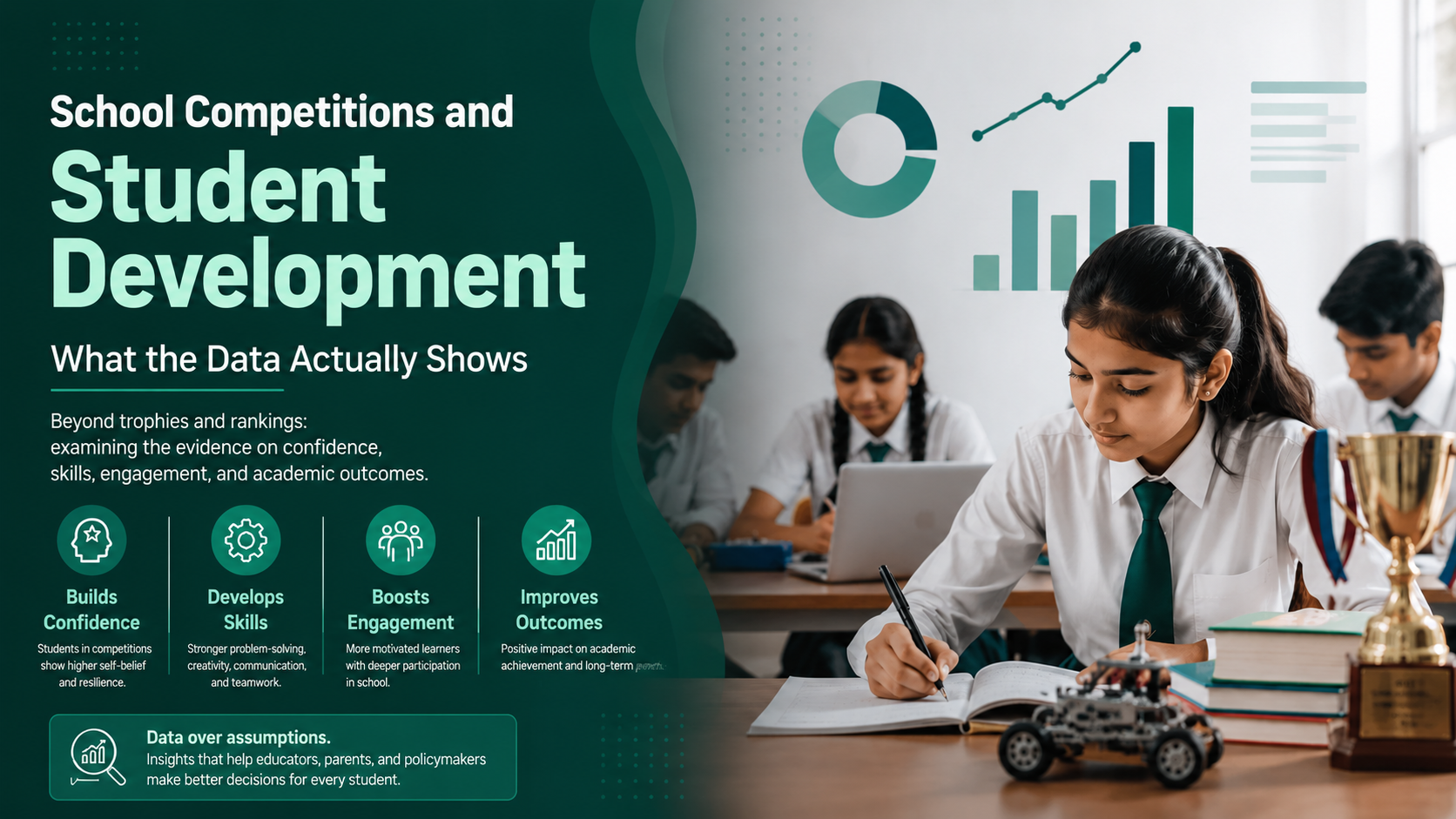
School Competitions and Student Development: What the Data Actually Shows
Every Indian school pours time, money, and prestige into competitions—Olympiads, debates, sports meets, cultural fests, science fairs. But the honest question most principals quietly carry is this: does any of it actually make students better, or does it mostly produce trophies and pressure? The relationship between school competitions and student development is more nuanced than either the "competitions build character" camp or the "competitions cause burnout" camp will admit. The research lands somewhere in between—and NEP 2020, NCF 2023, and PARAKH's Holistic Progress Card have quietly reframed what "better" even means.
This guide separates what the evidence supports from what brochures claim. By the end, you will know what competitions reliably develop, what they don't, why winning often matters less than principals assume, and how to design a competition calendar that builds skills without harming wellbeing or sidelining the students who never reach a national stage.
What Does "Better" Mean Under NEP 2020 and NCF 2023?
Before measuring impact, you have to define the target. For decades, "better" implicitly meant higher marks. NEP 2020 explicitly rejects that narrowing. It calls for a 360-degree view of the learner—academic ability alongside critical thinking, creativity, communication, collaboration, physical development, and socio-emotional skills.
NCF 2023 operationalises this by treating co-curricular participation as a genuine developmental domain, not an extracurricular afterthought. PARAKH's Holistic Progress Card (HPC) then puts it on paper: a single 360-degree record that captures academic, socio-emotional, and co-curricular growth together.
So when we ask whether competitions make a student "better," the policy answer is no longer "do they win more medals?" It is: do they develop a broader, deeper set of competencies, while staying well? That reframing changes which competitions are worth running—and how you judge them.
How Do School Competitions Affect Student Outcomes?
Here the evidence is encouraging but should be read carefully. Several studies—many international or older than three years—find that students who participate in co-curricular activities and competitions tend to show better academic outcomes, stronger engagement, and improved attendance, with attendance partly explaining the academic lift. The honest phrasing is associated with, not guaranteed by. Competitions correlate with development; they don't mechanically produce it.
Two findings are worth holding onto:
- Engagement is a real channel. International surveys of intra-school competition report higher motivation and a stronger sense of investment in studies among participants. The effect runs through engagement, not the trophy.
- Wellbeing predicts achievement, not the reverse. A 2022 study of roughly 3,400 secondary students found that higher student wellbeing predicted higher academic scores months later, even after controlling for prior performance. A pressured, anxious competitor is not on a path to better outcomes.
The takeaway for a principal: competitions are a lever for engagement and skill-building, but only when the experience itself is healthy.
Does Winning Matter More Than Participation?
This is the crux, and the data is fairly consistent: structured, consistent participation does more developmental work than the occasional win. Skills like resilience, communication, teamwork, and problem-solving are built through the cycle of preparing, performing, failing, and trying again—which every participant goes through, regardless of final rank. The trophy is a signal, not the mechanism.
This matters because a winning-obsessed culture quietly punishes the majority. If only medals "count," then 95% of your students draw no developmental credit from the same event that taught them plenty. A defensible assessment approach has to value the participation and the practice, not just the podium.
| Competition tends to help | Competition tends to hurt | |
|---|---|---|
| Framing | "What did you learn?" | "Did you win?" |
| Frequency | A few well-spaced events | Back-to-back, no recovery |
| Spread | Across multiple skill domains | One narrow domain, repeated |
| Access | Open to most students | Reserved for likely winners |
| Stakes | Mixed, mostly low-pressure | Uniformly high-pressure |
When Competition Hurts: Stress, Inequality, and Narrow Success
The risks are real and specifically Indian. Research on high-stakes competitive exam culture—the coaching-hub phenomenon being the sharpest example—documents significant anxiety, sleep loss, and emotional strain, with some studies concluding the structure imposes more harm than benefit. The lesson isn't "competition is bad." It's that competition without rest, balance, and a healthy frame can tip into damage.
Two failure modes deserve a principal's attention:
- Over-scheduling. When every term is crowded with high-pressure events, students lose the recovery time that makes practice productive.
- Access inequality. National competitions cluster around well-resourced urban schools. If your assessment only rewards national exposure, rural and budget-constrained students look weaker on paper despite genuine development.
Neither is a reason to stop competing. Both are reasons to design deliberately.
How NEP 2020, NCF 2023 and PARAKH Redefine Holistic Progress
For school leaders, the policy direction removes ambiguity. NEP 2020 mandates holistic, competency-based assessment. NCF 2023 supplies the stage-wise structure. PARAKH's HPC is the instrument that pulls academic, socio-emotional, and co-curricular signals into one 360-degree view.
Competitions, in this model, are simply one structured experience feeding a much larger profile—alongside classroom projects, clubs, service, and the arts. They are inputs to holistic development, not the scoreboard of it. That is liberating: it means a school doesn't need to win nationally to demonstrate strong holistic growth. It needs to offer breadth, track it fairly, and protect student wellbeing while doing so.
A practical note: HPC formats and board practices are still being operationalised across states. Build your approach around the durable principles—holistic, competency-based, 360-degree—rather than any one template that may change.
Designing a Healthy Competition Calendar for Your School
A competition calendar is a design problem, not a logistics problem. A few field-tested principles:
- Prioritise depth over volume. A small, well-chosen set of events beats a crowded one. There is no policy-prescribed "right number," but wellbeing research consistently favours fewer, better-spaced events.
- Spread across domains. Map your year across categories—sports, performing arts, literary, STEM, visual arts, community service—so different students find their footing, and individuals build breadth rather than repeating one narrow track.
- Lead with intra-school events. They are accessible to nearly every child and carry most of the developmental load. Treat inter-school and national events as enrichment, not the baseline.
- Build in debriefs. A short reflection after each event—what was learned, what to try next—converts a result into development and normalises failure as part of learning.
- Protect the academic calendar. Cluster events away from examination and revision windows.
If you want institutional support translating this into a trackable structure, see how schools implement Reportify across their timetables and report cards.
Beyond Trophies: Measuring Development, Not Just Wins
If participation and consistency matter more than wins, your measurement has to reflect that—otherwise you'll keep rewarding the wrong thing. This is where a structured scoring lens helps. Reportify's Co-curricular Skill Development (CSD) Score evaluates each event across five independent dimensions: skill relevance, participation volume, achievement, temporal consistency, and competition intensity. Crucially, achievement is just one of five inputs—so steady, broad participation is rewarded, and a single trophy can't manufacture a strong profile on its own. The CSD Framework methodology lays out exactly how this works.
The most consequential finding for Indian principals is an equity one. A thoughtfully designed calendar of just 5–6 intra-school events across different categories can already lift a student to a CSD Score above 4.5 on a 0–5 scale—a strong holistic profile achieved with zero national-level access. That single fact reframes the rural-versus-urban anxiety: holistic development does not require medals from a national stage; it requires breadth, consistency, and a fair way to count them. You can test this against your own school's activity mix using the free Skill Analyser.
This complements PARAKH's HPC; it doesn't replace it. The CSD approach is a structured, NEP 2020-aligned way to operationalise the same intent—built with research-and-incubation support from the IIM Lucknow Enterprise Incubation Centre.
Bringing It All Together
So—does winning competitions make a student better? Mostly no, not by itself. What develops students is structured participation, breadth across domains, consistent practice, and a frame that treats every event as learning rather than a verdict. Winning is a pleasant signal, not the engine. NEP 2020, NCF 2023, and PARAKH all push schools toward this wider definition of "better," and the equity data shows that even resource-limited schools can demonstrate strong holistic growth without a single national medal—if they design deliberately and measure fairly.
The practical next step is to see what your existing activities already produce:
- Try the Skill Analyser — model your school's events and watch the CSD Score respond.
- See how schools implement Reportify — fit holistic tracking into your timetable and report cards.
- Book a demo — walk through the full Holistic Score with your team.