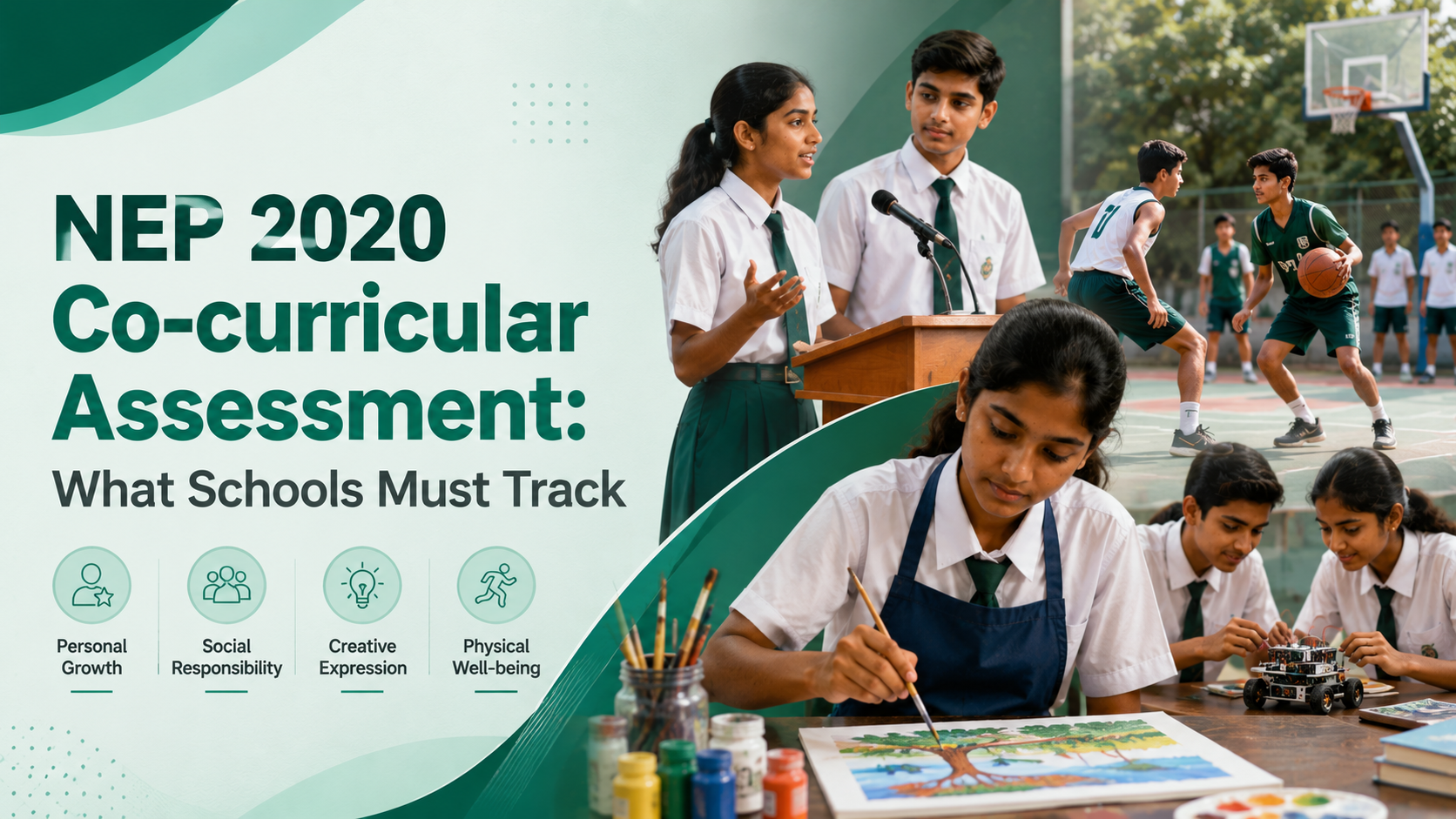
12 Skills Every School Should Track Beyond Academics
Marks measure recall. They do not measure whether a Class 9 student can hold an argument under pressure, whether she can lead six classmates through a science exhibition, or whether she can finish what she started in October when no one is watching. These are the skills every school should track if a report card is going to be honest about who a child is becoming. The mandate is already in policy — NEP 2020 calls for a 360-degree assessment framework, and NCF 2023 lays out twelve developmental domains as the core of holistic evaluation. The execution gap is what makes this hard.
This post is for principals and academic heads who are past the question of whether to track skills and now face the harder question: which twelve, why those, and how do you measure them without inviting subjective drift? By the end you will have a defensible list, a way to ground it in NEP and NCF, and a short path to start tracking by next term.
Why is marks-only assessment no longer enough?
A 95% in Mathematics tells you the student decoded the question paper. It does not tell you whether she can decode a real problem. CBSE's own co-scholastic framework (Circular Acad-31/2019) acknowledged this nearly a decade ago, but most schools still report it as A, B, or C grades in three broad areas — Work Education, Art Education, Health & Physical Education. The result is predictable: parents see marks they understand and co-scholastic grades they ignore.
The cost of this is not abstract. Selective universities, scholarship interviews, and increasingly employers are asking for evidence of skills, not just scores. The student leaving Class 12 with "first class with distinction" sits next to fifteen others with the same line on their CV. The differentiator is what she did in the four years that no exam tested.
The Holistic Progress Card released by PARAKH under NCERT is India's official answer to this gap. It expects schools to report on competencies, not just content mastery. Most schools do not yet have an instrument that can do this credibly.
What do NEP 2020 and NCF 2023 actually mandate?
NEP 2020 §4.6 commits the system to a "360-degree, multidimensional report" covering the cognitive, affective, and psychomotor domains. NCF 2023's position papers on holistic assessment identify twelve developmental domains as the working set — these are not a vendor invention; they are the policy floor.
What the policy does not give you is a scoring method. NCERT leaves that to schools and platforms. Which is why two principals reading the same NEP paragraph can build wildly different report cards — one with a five-point Likert scale, one with narrative comments, one with star ratings. None of these are comparable across schools, classrooms, or years.
A defensible tracking system needs three things: a fixed set of skills, a transparent scoring rule, and fairness across schools of different resource levels. The list below addresses the first.
The 12 skills every school should track
The working list below is grounded in NCF 2023 position papers, with Gardner's multiple intelligences and the CASEL social-emotional learning framework as cross-references.
# | Skill | What it looks like in practice |
|---|---|---|
1 | Critical Thinking | Builds an argument with evidence; spots a flawed conclusion |
2 | Creativity | Produces an original idea, design, or performance |
3 | Communication | Speaks, writes, and presents to be understood |
4 | Teamwork | Coordinates with others toward a shared outcome |
5 | Problem Solving | Breaks a problem down and tests solutions |
6 | Leadership | Takes initiative; carries responsibility for outcomes |
7 | Social Skills | Reads a room; resolves conflict; builds relationships |
8 | Motor Skills | Coordinates body, balance, and athletic capability |
9 | Self-Discipline | Sustains effort across weeks and months |
10 | Empathy | Takes another's perspective; responds with care |
11 | Cultural Awareness | Recognises and respects diverse heritage and expression |
12 | Citizenship | Contributes to community; understands civic duty |
Two principles make this list work as a tracking framework. First, the twelve are weighted equally — no school can argue that its strengths in Sports and Performing Arts should pull the average up while Self-Discipline and Empathy are quietly ignored. Second, the list is exhaustive enough that any genuine co-curricular event maps to at least one skill, and most events map to three or four. A debate competition develops Critical Thinking, Communication, and Self-Discipline. A folk dance performance develops Cultural Awareness, Teamwork, and Motor Skills. The mapping is what turns a participation log into a skill profile.
How do you score a skill without making it subjective?
The honest answer: you need a scoring rule that does not depend on a teacher's mood or a parent's reputation. Reportify's CSD Framework — developed at the IIM Lucknow Enterprise Incubation Centre — uses five independent dimensions for every one of the twelve skills:
Skill Relevance — how strongly the event develops a given skill, assigned through a published relevance matrix rather than ad-hoc judgement
Participation Volume — how many events the student attended, with diminishing returns so a single hyperactive month cannot game the system
Achievement — whether the student won, placed, or simply participated
Temporal Consistency — whether engagement was steady across the year or compressed into a fortnight before report cards were due
Competition Intensity — whether the event was intra-school, district, state, national, or international
The five dimensions are orthogonal — they capture independent signals — and the formula is auditable line by line. Any parent who asks "how did my child get a 72 in Leadership?" can be given the answer in the events that produced it. This is the property NEP 2020 implicitly demands but never specifies.
What does fair tracking look like in resource-strapped schools?
This is the question every principal in a Tier-2 or Tier-3 city asks within ninety seconds of seeing a holistic scoring system: won't this just hand the trophy to schools that can afford international Olympiad coaching?
It would, if the system rewarded only achievement and competition intensity. The CSD model deliberately does not. Of the five scoring dimensions, two — Participation Volume and Temporal Consistency — are about engagement, not competition. Reportify's published equity claim is that 5–6 intra-school events spread across different skill categories can take a student to a CSD Score of 4.5 or higher — well into the "Excellent" band — without any inter-school competition at all.
A school that runs an annual sports day, an in-house science fair, a class-level debate, an Independence Day cultural performance, and an NSS clean-up drive already has the raw material for full-spectrum skill tracking. The framework rewards what already exists — it does not demand new budgets.
How can a principal start tracking these 12 skills this term?
Three concrete steps work in any CBSE-affiliated school regardless of size.
Audit your existing event calendar first. Most schools run thirty to forty events a year — annual day, sports week, classroom debates, district competitions, NSS drives. Tag each event against the twelve skills. You will almost certainly find you are already developing nine or ten of them; the recurring gaps tend to be Empathy, Cultural Awareness, and Citizenship, which can be filled with one or two intentional programmes per term.
Decide who owns the data before you start. A skill-tracking system fails when a class teacher is asked to do it manually on Excel. Either the platform auto-populates from event records — which is the only model that survives the second term — or you assign a dedicated co-curricular coordinator with budgeted time.
Show parents the skill profile alongside the marks page. A parent who sees their child's profile — with a low score in Self-Discipline backed by attendance data — engages with the report card differently from one who only sees marks. The report card stops being a transcript and starts being a conversation.
Try the calculation on a sample student: the Reportify Skill Analyser lets you build a profile and watch all twelve skill scores update live, with no login.
Bringing it all together
The twelve skills are not a wishlist. They are the policy floor under NEP 2020 and NCF 2023, the developmental scaffold under PARAKH's Holistic Progress Card, and the most honest description we currently have of what a school's job is beyond board exams. The hard part is not agreeing on the list — most principals nod through this section of any conference. The hard part is committing to a scoring method that is transparent, comparable, and fair to schools that do not run on Tier-1 budgets. That commitment is what turns "we develop the whole child" from a marketing line into something a parent can read on a page.
Next steps:
Try the Skill Analyser — build a student profile and see all twelve skills score in under two minutes.
See how schools implement Reportify — what changes in the first term, and what does not.
Book a demo — fifteen minutes, no slides, just your report card on screen.